Author name: Makarand Mirge

As Director and Co-Founder at Alligator Solar, Mr. Makarand Mirge brings over 13 years of hands-on experience in transforming idle roofs and land into reliable power assets for businesses. He works closely with cross-functional teams to ensure that every solar PV system Alligator Solar delivers is engineered for long-term performance, financial viability, and measurable impact on energy costs and emissions. With a strong background across project management, business development, and quality assurance in the renewable energy sector, he has led and guided multiple commercial and industrial installations under varied site conditions. This journey has shaped his core belief that clear planning, transparent risk discussions, and disciplined execution matter far more than claims, especially when supporting clients in moving closer to SDG-7 goals on clean, reliable power. Mr. Mirge is certified in Agile Project Leadership and Business Development Foundations, enabling him to steer projects and teams with both structure and agility. His focus remains on building Alligator Solar as a future-ready, dependable solar EPC partner that consistently creates long-term value for customers, employees, and collaborators.

Solar Open Access vs Rooftop Solar
Blog, Commercial Solar Rooftop, Solar Open Access

Solar Open Access vs Rooftop Solar: Which Is Better for Your Business?

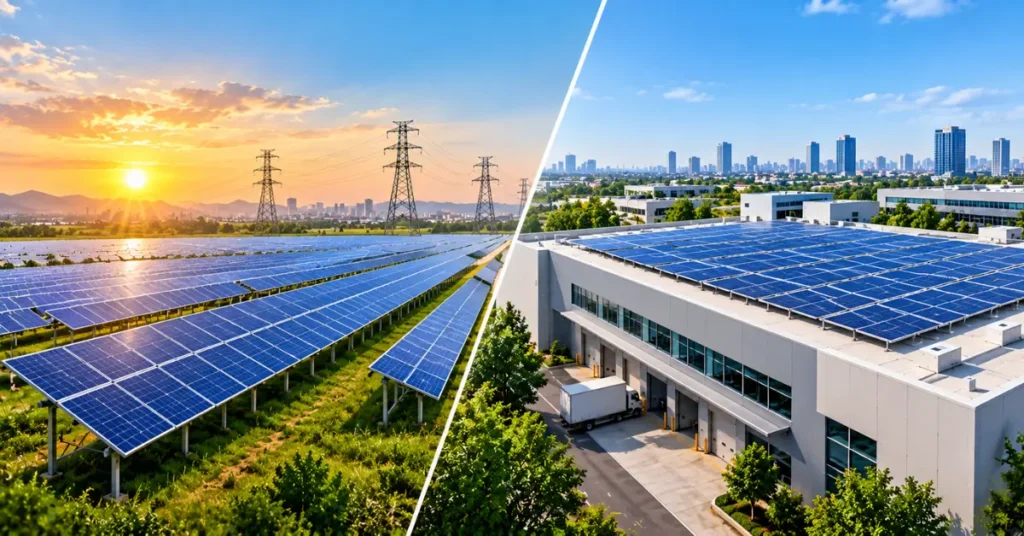
Introduction For businesses looking to reduce electricity costs and increase renewable energy use, solar open access and rooftop solar are two practical options.  But which one is better for your business?   Rooftop solar can be suitable for businesses with sufficient roof space and strong daytime electricity consumption. Solar open access may be suitable for businesses with high electricity demand, limited rooftop space, or a need for larger renewable energy capacity.  In this article, we have briefly compared solar open access vs rooftop solar on key factors such as investment, space, savings, and scalability.  This comparison can help businesses understand which solar solution may be more suitable for their needs.  What Is Solar Open Access? Solar open access allows eligible businesses to procure renewable electricity from a power generator through the electricity grid, subject to applicable regulations, contracts and charges.  The electricity is supplied through the existing power grid under applicable open-access regulations and commercial arrangements. This model can be useful for businesses with high electricity consumption or limited space for installing a large solar system at their facility. Depending on the arrangement, a business may enter into a power purchase agreement or another suitable procurement structure. Since regulations, charges, and eligibility requirements can vary between states, businesses should evaluate the applicable rules before making a decision. Also Read: Solar Open Access in India: Complete Guide for Businesses  What Is Rooftop Solar? A commercial solar rooftop system is a solar power system installed on the roof of a business, office, warehouse, or industrial building. It uses sunlight to generate electricity that can be used to run the company’s day-to-day operations.  The generated power can be used directly by the facility, reducing the amount of electricity it needs to purchase from the grid. A rooftop system can be suitable for businesses that have: A professional site assessment is important before beginning solar installation. Factors such as roof strength, shading, equipment placement, and available area can affect the size and performance of the system. Key Differences: Solar Open Access vs Rooftop Solar The table below highlights the major differences between solar open access and rooftop solar across key factors such as location, space, scalability, investment, and maintenance.  Factor Solar Open Access Rooftop Solar Location Off-site On-site Rooftop space Not required Required Scalability Generally higher Limited by available space Installation at premises Minimal Required Investment Model PPA or other structures may be available CAPEX, financing or other models Maintenance at facility Usually limited Required Best suited for High energy demand and limited space Facilities with suitable roofs Cost and Savings Cost is an important consideration when comparing both options. With rooftop solar, the business typically needs to account for solar panels, inverters, mounting structures, electrical components, installation, and ongoing maintenance. However, the system can generate electricity for many years, potentially providing substantial long-term savings. Solar open access can reduce the need for a business to develop a large solar plant at its own facility. However, the overall economics depend on more than the solar generation tariff. Transmission, wheeling, banking, cross-subsidy, and other applicable charges can influence the final delivered electricity cost. Therefore, businesses should compare the total cost of delivered power instead of considering only the initial solar tariff or installation cost. Space and Scalability Available space is one of the biggest differences between the two options. Rooftop solar depends on the amount of usable roof area. HVAC units, water tanks, skylights, shading, structural limitations, and access pathways can reduce the area available for panels. Consequently, businesses with high electricity requirements may not be able to install enough capacity on their roofs. Solar open access removes this physical limitation because the solar generating project can be located off-site.  This can make it attractive for large industrial facilities, warehouses, and commercial operations that need more renewable power than their premises can accommodate. Installation and Maintenance Rooftop solar requires detailed planning and on-site execution. The process generally includes site assessment, system design, equipment selection, installation, testing, commissioning, and ongoing maintenance. Businesses should carefully evaluate solar installation companies before selecting a project partner. Experience with commercial and industrial projects, engineering capabilities, equipment quality, safety standards, warranties, and after-sales support are important considerations. Open access reduces the need for major solar infrastructure at the consumer’s premises. However, businesses still need to assess contractual arrangements, grid connectivity, regulatory requirements, and applicable charges. Also Read: Why Choosing the Right Industrial Solar Company Matters  Solar Installation in India: What Businesses Should Consider The suitability of each model can vary across locations. Businesses evaluating solar installation in India should consider electricity tariffs, consumption patterns, available roof space, solar potential, financing options, grid conditions, and applicable state regulations. For open-access projects, state-specific policies and charges can significantly affect project economics. A solution that works well for one business may not necessarily provide the same benefits for another. A detailed feasibility assessment can help businesses compare expected savings and operational requirements before making a long-term commitment. Which Option Is Better for a Business? Neither rooftop solar nor solar open access is universally better. The right choice depends on a business’s electricity consumption, available space, financial objectives, and long-term energy strategy.  Rooftop Solar is suitable when: Solar Open Access is suitable when: A Hybrid Approach Businesses do not always have to choose only one option. A business may use rooftop solar for part of its electricity requirement and source additional renewable power through open access. This approach can help businesses make better use of available roof space while accessing additional renewable energy capacity. Businesses may also consider battery energy storage alongside rooftop or open-access solar where energy storage, peak-demand management, or backup support is required.  Also Read: Battery Energy Storage System: Why Businesses Need It  Conclusion The decision between solar open access and rooftop solar should be based on a business’s energy consumption, available space, financial objectives, regulatory environment, and future growth plans. Rooftop solar can work well for businesses with suitable premises and strong daytime consumption. Open access can provide greater flexibility for
Engineering Matter in a Solar EPC Company
Blog, Solar EPC Company

Why Does Engineering Matter in a Solar EPC Company?

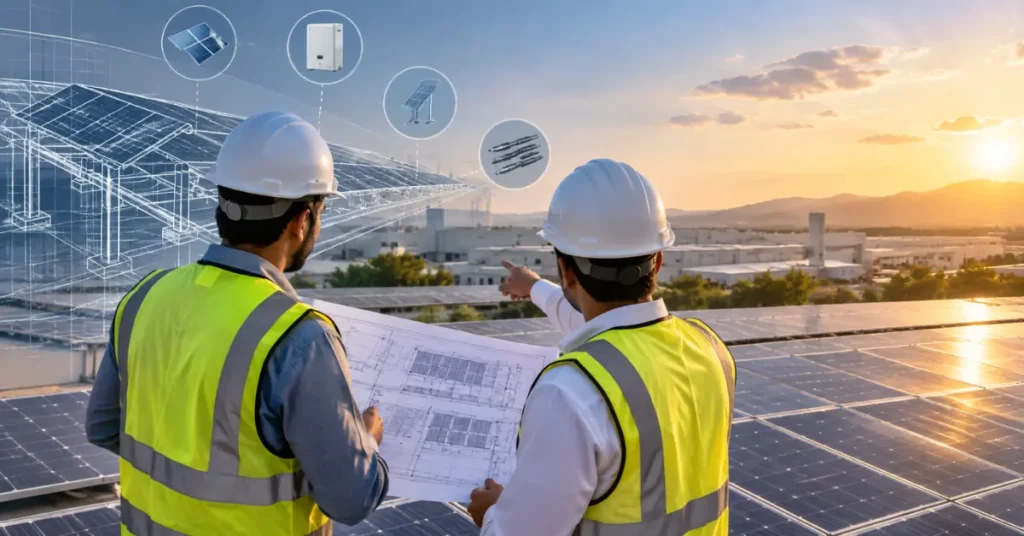
Introduction For many industries, increasing power costs and unreliable energy supply can directly affect operational expenses and productivity. At the same time, businesses are under growing pressure to reduce their carbon footprint.  Solar energy offers a practical way forward, but managing design, equipment, installation, and performance can be challenging without the right expertise. A solar EPC company brings these requirements together under one roof, managing everything from engineering and procurement to installation and commissioning.  This article explores why engineering expertise is essential when choosing a solar EPC company and how the right technical knowledge can improve the efficiency, reliability, and long-term performance of an industrial solar project.  1. Understanding the Role of Engineering in a Solar EPC Project Engineering forms the foundation of a solar project. Before installation begins, technical teams assess the site, understand the facility’s energy consumption, study available space, and identify potential limitations. The findings help determine the appropriate system capacity, equipment configuration, mounting method, electrical design, and safety measures. Good engineering also ensures that procurement and construction follow a design that is technically practical rather than relying on standard assumptions. 2. What Solar Engineering Covers Before Installation Solar engineering involves several important activities before a project reaches the installation stage. These may include: This preparation gives the project team a clearer understanding of what can realistically be installed and how the system should operate. 3. How Engineering Helps Design the Right Solar System Every commercial or industrial facility has different energy requirements. A system that works well for one factory may not be suitable for another. Engineering helps match system capacity with electricity demand and available installation space. It also considers module orientation, shading, inverter configuration, equipment compatibility, and future expansion requirements. A properly engineered design can make better use of available space while reducing avoidable losses and technical complications. 4. Engineering for Different Commercial and Industrial Sites Solar projects can be installed across factories, warehouses, offices, educational facilities, hotels, and other commercial properties. Each site can present different engineering challenges. For example, a rooftop project may require structural checks and careful planning around existing equipment, walkways, drainage, and maintenance areas. Ground-mounted projects may require different considerations related to land conditions, foundations, cable routes, and site layout. This is why experienced solar EPC companies should evaluate the individual characteristics of every project instead of applying a one-size-fits-all design. Also Read: Why Choosing the Right Industrial Solar Company Matters 5. How Good Engineering Improves Solar Project Performance Strong engineering can influence the performance and reliability of a solar plant throughout its operating life. A well-planned system can improve space utilisation, minimise unnecessary electrical losses, support safer installation, and make maintenance easier. It can also help identify potential problems before construction begins. Addressing these issues during the design stage is generally easier and less disruptive than correcting them after equipment has been installed. 6. Common Engineering Mistakes That Increase Project Risks Weak engineering can create problems that become expensive to correct later. Common issues include: Such mistakes can affect generation, safety, project timelines, and long-term operating costs. Thorough engineering helps reduce these risks before they reach the construction stage. 7. What to Look for in a Solar EPC Company’s Engineering Expertise When comparing solar EPC companies in India, businesses should look beyond pricing and equipment brands. A reliable partner should be able to demonstrate technical knowledge through project experience, detailed site assessments, engineering documentation, realistic generation estimates, and clear design explanations. Businesses can also review completed projects with similar capacities and site conditions. This can provide a better indication of whether the provider understands the technical requirements of commercial and industrial installations. For businesses searching for the best solar EPC companies in India, engineering capability should therefore be treated as a key selection criterion rather than an additional feature. 8. Why Alligator Solar Takes an Engineering-Led Approach Alligator Solar follows a commercial and industrial (C&I)-focused approach, supporting businesses with solutions designed around their operational and energy requirements. Its offering covers onsite solar, rooftop and ground-mounted systems, open access solar, OPEX/CAPEX models, battery energy storage, EV charging, and asset management. Also Read: Battery Energy Storage System: Why Businesses Need It The company has completed 250+ projects, operates across 10+ states, has more than 10 years of experience, and reports 95% customer satisfaction. Its integrated approach brings engineering, procurement, installation, commissioning, and ongoing asset management together. Conclusion Engineering expertise can make a significant difference to the success of a commercial or industrial solar project. From understanding site conditions and energy requirements to selecting equipment and planning installation, engineering influences almost every stage of the project. Businesses should therefore evaluate an EPC provider on more than price. Technical capability, relevant project experience, design quality, safety planning, execution, and long-term support all deserve careful consideration.  Looking for an experienced solar EPC partner for your commercial or industrial project?  Connect with Alligator Solar to discuss your energy requirements and explore a suitable solar solution.  Frequently Asked Questions
Is Your Commercial Roof Ready for Solar 8 Things to Check
Blog, Commercial Solar Rooftop

Is Your Commercial Roof Ready for Solar? 8 Things to Check Before Installation

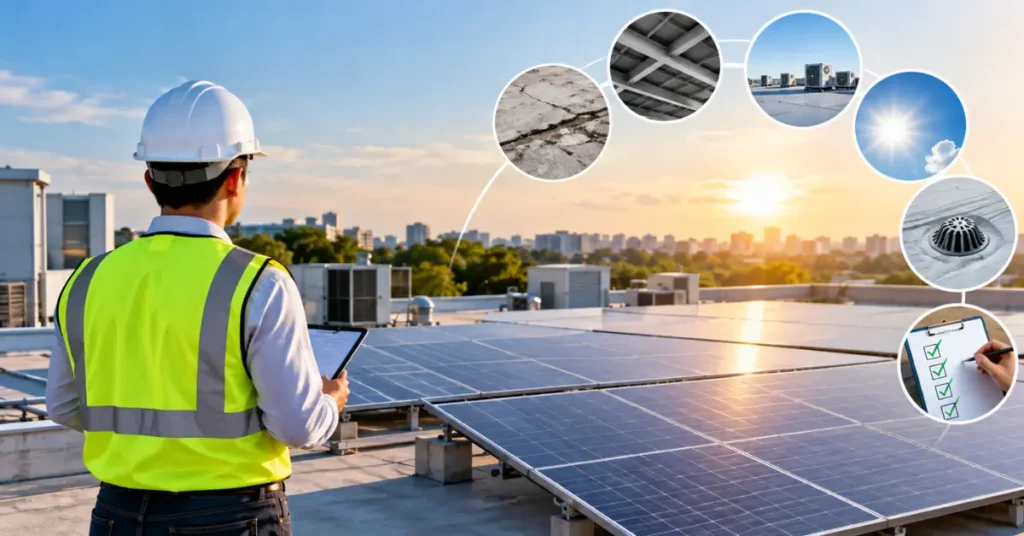
Introduction Installing commercial rooftop solar can help businesses lower electricity costs while making better use of unused roof space. However, not every commercial roof is ready for a solar installation, and installing panels without checking the roof first can lead to unexpected problems and additional costs. Before moving ahead, businesses should evaluate the roof’s age, condition, structural strength, available space, and sunlight exposure. A proper assessment can help identify potential issues early and make the installation process smoother and more reliable. So, what should businesses check before installing solar panels on a commercial roof? Here are 8 important things to consider. 1. Check Your Roof’s Age The roof’s age is one of the first things to consider. Solar panels are a long-term investment, so the roof should ideally have sufficient remaining life. If the roof is already nearing the end of its lifespan, installing solar before replacing it may create additional costs. Solar panels may need to be removed and reinstalled when the roof is replaced. 2. Inspect the Roof Condition Before solar installation, check for leaks, cracks, corrosion, damaged waterproofing, or other signs of deterioration. Existing problems should ideally be repaired before solar panels and mounting structures are installed. Fixing roof issues later can be more difficult and expensive. 3. Assess Structural Strength Solar panels and mounting structures add weight to the roof. Therefore, the building should be assessed to determine whether it can safely support the proposed solar system. A structural assessment is especially important for older commercial buildings and large industrial facilities. 4. Consider Your Commercial Roof Type Different commercial roofs require different solar mounting solutions. Flat roofs, metal roofs, and membrane roofs may each require specific installation methods. The mounting system should be selected according to the roof material, slope, structural capacity, and drainage requirements. 5. Measure the Usable Roof Space Not every part of a commercial roof can be covered with solar panels. HVAC units, water tanks, vents, skylights, walkways, and other equipment can reduce the usable area. A professional site survey can determine the available space and help create an efficient panel layout while maintaining access for maintenance. Also Read: Solar Open Access in India: Complete Guide for Businesses  6. Check Sunlight Exposure and Shading Solar panels need sufficient sunlight for efficient energy generation. Shadows from nearby buildings, trees, parapet walls, or rooftop equipment can reduce system output. Experienced solar installation companies can assess the site’s solar exposure and design the panel layout to minimise unnecessary shading. 7. Check Drainage and Accessibility Solar installation should not interfere with the roof’s drainage system. Poor drainage can cause water accumulation and potentially affect the roof over time. There should also be adequate access for cleaning, inspection, repairs, and maintenance. A good solar design considers both energy generation and long-term roof accessibility. A professional energy assessment can help determine whether a battery energy storage system is technically and financially suitable for a particular facility. 8. Choose the Right Installation Partner Choosing an experienced installation partner is essential for a successful commercial solar project. An experienced solar company can assess your roof and recommend a system based on its structure and your energy requirements.  Check the company’s previous projects, technical expertise, equipment quality, installation standards, warranties, and after-sales support. An experienced solar company can manage engineering, procurement, construction, installation, testing, and commissioning under one coordinated process. Also Read: Why Choosing the Right Industrial Solar Company Matters What If Your Roof Is Not Ready for Solar? If your roof requires repairs or structural improvements, you may not need to cancel your solar plans. Depending on its condition, you can consider repairs, waterproofing, structural upgrades, or roof replacement before installing solar. For an ageing roof, replacing it before commercial solar power installation may be more practical than removing the solar system later. Why Choose Alligator Solar for Commercial Rooftop Solar? At Alligator Solar, our commercial rooftop projects are built around each business’s energy needs and site conditions. As a C&I-focused solar EPC partner, we bring 10+ years of experience, 250+ projects, and a presence across 10+ states, with a 95% customer satisfaction rate.  Our solutions include rooftop and ground-mounted solar, open access, OPEX/CAPEX models, battery energy storage, EV charging, and asset management. Also Read: Solar EPC Company Guide: How to Choose the Right Partner Conclusion Your commercial roof is an important part of your solar investment. Before starting solar installation, make sure the roof is strong, reliable, accessible, and suitable for the proposed system. Checking its age, condition, structure, roof type, usable area, shading, drainage, and installation requirements can help businesses avoid unnecessary complications. With proper planning and the support of experienced professionals, commercial rooftop solar can turn unused roof space into a valuable source of clean electricity. Frequently Asked Questions
Battery Energy Storage System Why Businesses Need It
Battery Energy Storage System, Blog

Battery Energy Storage System: Why Businesses Need It

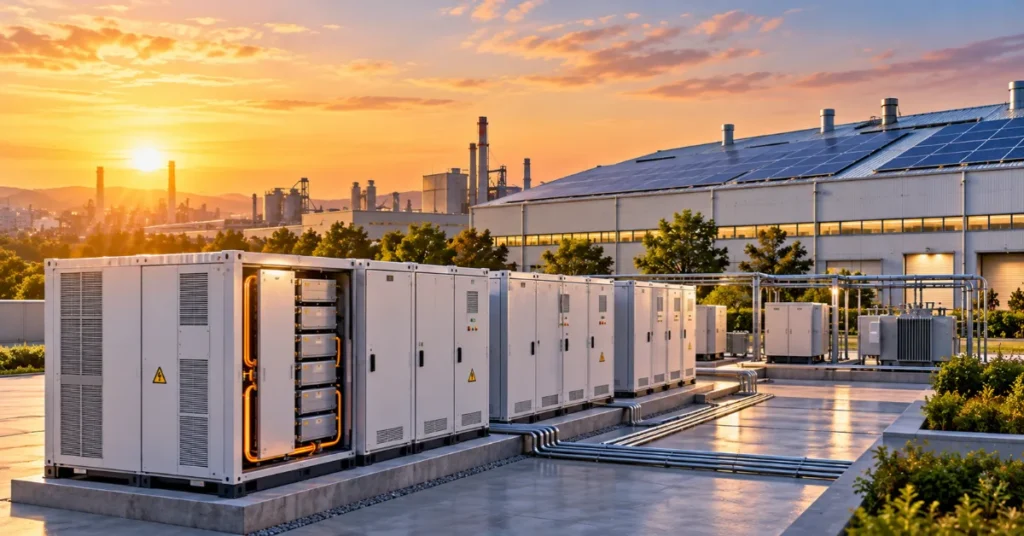
Introduction Rising electricity costs, peak demand and unexpected power interruptions can affect business operations. Solar power can reduce dependence on grid electricity, but solar generation is limited to periods when sunlight is available. A battery energy storage system (BESS) helps address this limitation by storing electricity and supplying it when required. When integrated with solar, a battery energy storage system can store excess daytime generation and make it available when solar output falls. In this article, we will explore how BESS works, its key benefits and applications, and why battery energy storage systems in India are becoming an important part of modern energy management. What Is a Battery Energy Storage System A battery energy storage system combines batteries with power conversion, monitoring and control equipment to store electricity for later use. Electricity stored in a BESS can come from the grid or renewable sources such as solar. The stored energy can then be supplied when demand increases, solar generation decreases, or additional power support is required. This makes battery storage more than a backup solution. It can also form part of a business’s broader energy management strategy. How Does a Battery Energy Storage System Work A battery energy storage system works through four basic stages: When paired with solar, BESS can store surplus daytime generation and supply it later, helping businesses use more of the electricity generated by their solar system. How Can a Battery Energy Storage System Help Businesses A battery energy storage system can help commercial and industrial facilities address several energy challenges: Benefits of a Battery Energy Storage System For businesses, a properly designed battery energy storage system can provide: Applications of Battery Energy Storage Systems A battery energy storage system can support different commercial and industrial applications. Manufacturing facilities can use battery storage for peak-demand management and operational continuity. Commercial buildings can use BESS to support essential loads during power interruptions. Hospitals, data centres and other critical facilities can use battery storage for rapid backup support. BESS can also be integrated with EV charging infrastructure, where high-power charging can increase electricity demand. Another important application is combining BESS with rooftop or open-access solar. This allows businesses to store renewable electricity during periods of high solar generation and use it later. Also Read: Solar Open Access in India: Complete Guide for Businesses  BESS Applications at a Glance Application Primary Purpose Business Benefit Peak-demand management Reduce demand peaks Energy cost management Solar energy shifting Store excess solar energy Better solar utilisation Backup power Support critical loads Improved power reliability EV charging support Manage charging demand Greater energy flexibility Battery Energy Storage System in India: What Businesses Should Consider Battery energy storage systems in India are becoming increasingly relevant as businesses adopt renewable energy and look for greater flexibility in electricity management. For businesses considering BESS, the system should be selected according to the facility’s actual energy requirements. Important factors include: A professional energy assessment can help determine whether a battery energy storage system is technically and financially suitable for a particular facility. Also Read: Why Choosing the Right Industrial Solar Company Matters  Battery Energy Storage System Market: What Does the Future Hold The battery energy storage system market is becoming increasingly important as renewable energy adoption expands and businesses seek more flexible ways to manage electricity. For commercial and industrial users, BESS is moving beyond conventional backup applications. Its integration with solar, EV charging and energy management systems can help businesses better coordinate electricity generation, storage and consumption. Future BESS adoption will depend on factors such as technology, project economics, energy requirements and India’s evolving energy infrastructure. Is a Battery Energy Storage System Suitable for Your Business BESS is not a one-size-fits-all solution. Its suitability depends on electricity consumption, load profile, peak demand, solar generation, backup requirements, available space and project economics. Businesses with significant peak demand, critical loads, excess solar generation or a need for greater energy flexibility can evaluate BESS as part of their long-term energy strategy. Conclusion A battery energy storage system can help commercial and industrial businesses manage peak demand, improve power reliability and make better use of renewable energy. When combined with solar, BESS can store large amounts of electricity and make it available when solar generation is lower. However, the right system depends on the facility’s load profile, energy requirements and financial objectives. A professional assessment and appropriate system design can help businesses determine whether BESS is the right solution for their energy needs. Frequently Asked Questions
Solar Open Access in India
Blog, Solar Open Access

Solar Open Access in India: Complete Guide for Businesses

Introduction Large industrial businesses often require more electricity than their rooftop solar panels can generate. Even with full utilisation of available rooftop space, rooftop solar may meet only part of their energy requirements.   Solar open access allows businesses to obtain energy from off-site solar projects through the existing grid.  This approach helps reduce energy costs and carbon emissions without the need for a large on-site solar installation. What Is Solar Open Access? Solar open access operates within the framework of the Electricity Act, 2003, which allows eligible commercial and industrial consumers to procure electricity from solar power generators of their choice instead of their local DISCOM (Distribution Company). This system uses large, off-site solar plants that feed power into the state or central grid. Consumers can draw an equivalent amount of electricity at their facilities, with transactions monitored through grid accounting. This approach supports energy independence and sustainable energy development.   In simple terms,  a factory can purchase solar power from a solar project located far from its facility, using existing infrastructure for efficient delivery. How Does Solar Open Access Work in India? The process generally involves the following steps: Step 1: Check Eligibility Businesses first need to check whether they meet the eligibility requirements for solar open access. In many cases, the minimum contracted demand is 100 kW, although the exact requirement can vary from one state to another. Step 2: Sign a Power Purchase Agreement (PPA) The business enters into a Power Purchase Agreement (PPA) with a solar company. The agreement outlines the electricity tariff, contract terms, duration, and other commercial conditions, which can extend over several years.  Also Read: Solar EPC Company Guide: How to Choose the Right Partner  Step 3: Solar Power Is Generated The solar company generates electricity at an off-site solar plant and supplies the power to the transmission or distribution grid. Step 4: Electricity Reaches the Business The business continues to receive electricity at its facility through the existing grid. The relevant authorities account for the energy supplied through the solar open access arrangement. Step 5: Pay the Solar Tariff and Applicable Charges The business pays the agreed solar power tariff along with applicable transmission, wheeling, cross-subsidy and other charges. The overall cost can be more competitive than conventional grid electricity, depending on the business’s location, tariff structure and consumption profile. Why Are Businesses Choosing Solar Open Access? 1. Cost Optimisation High industrial electricity tariffs make power procurement expensive in many states. Solar open access can provide a more competitive rate when all charges are considered, leading to annual savings for high-consumption facilities. This approach supports long-term cost optimisation and financial sustainability. 2. No Rooftop Space Requirement  Because generation occurs off-site, businesses do not need sufficient rooftop space to accommodate their entire solar capacity. 3. Potentially Lower Upfront Investment Under certain third-party PPA or OPEX structures, businesses can access solar power without the upfront capital investment required to own and develop a full solar plant. The investment requirement depends on the chosen structure. 4. Renewable Energy Adoption Open access can help businesses increase their use of renewable electricity and support broader sustainability and energy transition goals. India introduced the Green Energy Open Access Rules to promote generation, purchase and consumption of green energy. Solar Open Access vs Rooftop Solar Solar open access and rooftop solar provide businesses with different ways to adopt renewable energy. With solar open access, electricity is generated at an off-site solar project and supplied through the grid. With rooftop solar, electricity is generated directly at the business’s premises. Also Read: Why Should Modern Businesses Choose Commercial Solar Rooftop The table below highlights the key differences between solar open access and rooftop solar: Factor Solar Open Access Rooftop Solar Generation Off-site On-site Rooftop Requirement No Yes Scalability Suitable for larger requirements Limited by available space Ownership Depends on structure Usually owned or financed on-site Grid use Power delivered through the grid Primarily on-site generation Is Solar Open Access Right for Your Business? Solar open access may be a suitable option for large industrial and commercial consumers with significant monthly electricity costs. The benefits, including cost savings and procurement flexibility, may outweigh any additional charges based on the project structure. This method allows businesses to effectively manage energy through the grid rather than relying solely on on-site solutions. Also Read: Why Choosing the Right Industrial Solar Company Matters For facilities with available rooftop space, combining rooftop solar for daytime electricity demand with open access for additional energy demand can be an effective approach. It enhances renewable energy usage while reducing dependence on a single energy source, promoting sustainability and cost savings. Frequently Asked Questions
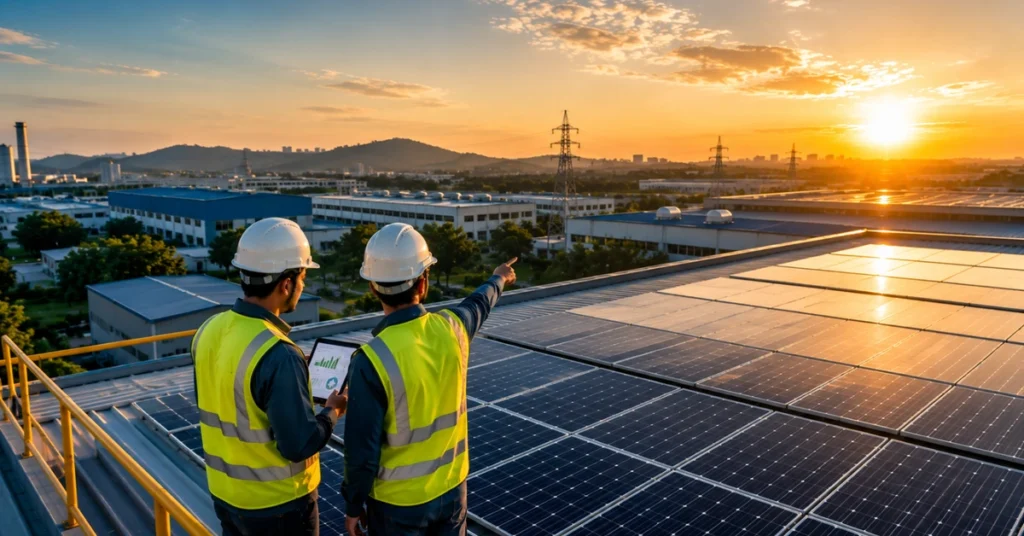
Industrial Solar Company
Blog, Commercial Solar Rooftop

Why Choosing the Right Industrial Solar Company Matters

Introduction For commercial and industrial businesses, electricity is a major operating expense that can directly influence production costs and long-term profitability. As businesses seek to control energy costs and meet sustainability goals, solar power has become a practical investment for factories, warehouses, manufacturing facilities, and other large-scale facilities. However, installing solar is not simply about purchasing panels. The right industrial solar company can make a significant difference in system design, energy generation, safety, project execution, and long-term returns. This is why businesses should evaluate the expertise and capabilities of their solar partner before investing. Why Industrial Businesses Are Investing in Rooftop Solar Large industrial facilities often have substantial rooftop areas that can be converted into productive energy assets. Industrial rooftop solar allows businesses to generate electricity at the point of consumption, helping to offset daytime grid consumption and reduce dependence on grid power. A professionally designed rooftop system can also make better use of available roof space while considering structural requirements, safety clearances, load profiles, and future expansion plans. What Services Should an Industrial Solar Company Provide A professional solar company provides much more than just industrial solar installation. The process should begin with understanding the facility and continue through engineering, execution, commissioning, and ongoing support. 1. Site Survey & Energy Assessment Before designing a solar system, engineers assess electricity consumption, roof or land availability, structural strength, existing electrical infrastructure, and future energy requirements. This helps create the right solar system based on the site’s specific needs rather than relying on a standardised design. 2. System Design & Engineering The design is tailored to the facility’s load profile and operational requirements. Factors such as module placement, mounting structures, electrical architecture, safety, generation potential, and monitoring should be considered. Alligator Solar conducts thorough pre-design site audits to create efficient rooftop and ground-mounted solar plants. We assess site constraints, prioritise safety, analyse load profiles, and factor in future expansion, ensuring tailored solutions that maximise your investment. 3. Industrial Solar Installation High-quality industrial solar installation requires engineering precision and safe project execution. An experienced industrial solar company manages the installation process to minimise disruption to ongoing industrial operations. What to Look for in an Industrial Solar Company Before selecting a solar partner, businesses should consider: Alligator Solar is your trusted partner for industrial solar solutions. We provide end-to-end project management, prioritise safety in execution, and offer reliable maintenance. With flexible financing options, transitioning to sustainable energy has never been easier. Let us help you harness solar power for a greener future. Benefits of Professional Industrial Solar Installation Choosing an experienced provider for industrial solar panel installation can help businesses achieve better system performance and long-term value.  Proper engineering can optimise available space and maximise energy generation, while quality installation and monitoring can support reliable operation. Conclusion Choosing the right industrial solar company is ultimately a business decision, not just a technology purchase. From energy assessment and system engineering to industrial solar panel installation, monitoring, and O&M, the capabilities of an industrial solar company can influence a project’s long-term performance and financial value. Frequently Asked Questions