
Introduction
Installing commercial rooftop solar can help businesses lower electricity costs while making better use of unused roof space. However, not every commercial roof is ready for a solar installation, and installing panels without checking the roof first can lead to unexpected problems and additional costs.
Before moving ahead, businesses should evaluate the roof’s age, condition, structural strength, available space, and sunlight exposure. A proper assessment can help identify potential issues early and make the installation process smoother and more reliable.
So, what should businesses check before installing solar panels on a commercial roof?
Here are 8 important things to consider.
1. Check Your Roof’s Age
The roof’s age is one of the first things to consider. Solar panels are a long-term investment, so the roof should ideally have sufficient remaining life.
If the roof is already nearing the end of its lifespan, installing solar before replacing it may create additional costs. Solar panels may need to be removed and reinstalled when the roof is replaced.
2. Inspect the Roof Condition
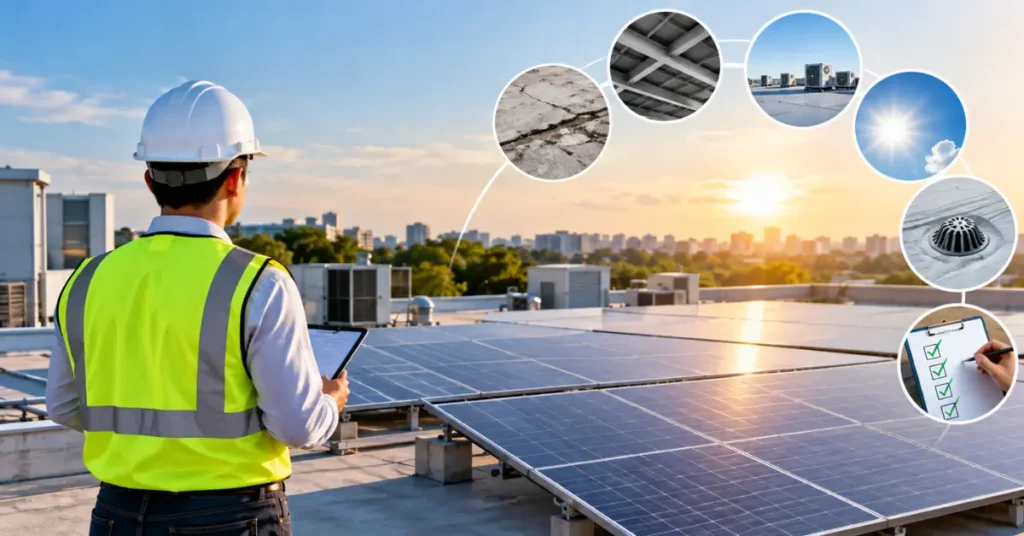
Before solar installation, check for leaks, cracks, corrosion, damaged waterproofing, or other signs of deterioration.
Existing problems should ideally be repaired before solar panels and mounting structures are installed. Fixing roof issues later can be more difficult and expensive.
3. Assess Structural Strength
Solar panels and mounting structures add weight to the roof. Therefore, the building should be assessed to determine whether it can safely support the proposed solar system.
A structural assessment is especially important for older commercial buildings and large industrial facilities.
4. Consider Your Commercial Roof Type
Different commercial roofs require different solar mounting solutions. Flat roofs, metal roofs, and membrane roofs may each require specific installation methods.
The mounting system should be selected according to the roof material, slope, structural capacity, and drainage requirements.
5. Measure the Usable Roof Space
Not every part of a commercial roof can be covered with solar panels. HVAC units, water tanks, vents, skylights, walkways, and other equipment can reduce the usable area.
A professional site survey can determine the available space and help create an efficient panel layout while maintaining access for maintenance.
Also Read: Solar Open Access in India: Complete Guide for Businesses
6. Check Sunlight Exposure and Shading
Solar panels need sufficient sunlight for efficient energy generation. Shadows from nearby buildings, trees, parapet walls, or rooftop equipment can reduce system output.
Experienced solar installation companies can assess the site’s solar exposure and design the panel layout to minimise unnecessary shading.
7. Check Drainage and Accessibility
Solar installation should not interfere with the roof’s drainage system. Poor drainage can cause water accumulation and potentially affect the roof over time.
There should also be adequate access for cleaning, inspection, repairs, and maintenance. A good solar design considers both energy generation and long-term roof accessibility.
A professional energy assessment can help determine whether a battery energy storage system is technically and financially suitable for a particular facility.
8. Choose the Right Installation Partner
Choosing an experienced installation partner is essential for a successful commercial solar project. An experienced solar company can assess your roof and recommend a system based on its structure and your energy requirements.
Check the company’s previous projects, technical expertise, equipment quality, installation standards, warranties, and after-sales support.
An experienced solar company can manage engineering, procurement, construction, installation, testing, and commissioning under one coordinated process.
Also Read: Why Choosing the Right Industrial Solar Company Matters
What If Your Roof Is Not Ready for Solar?
If your roof requires repairs or structural improvements, you may not need to cancel your solar plans. Depending on its condition, you can consider repairs, waterproofing, structural upgrades, or roof replacement before installing solar.
For an ageing roof, replacing it before commercial solar power installation may be more practical than removing the solar system later.
Why Choose Alligator Solar for Commercial Rooftop Solar?
At Alligator Solar, our commercial rooftop projects are built around each business’s energy needs and site conditions. As a C&I-focused solar EPC partner, we bring 10+ years of experience, 250+ projects, and a presence across 10+ states, with a 95% customer satisfaction rate.
Our solutions include rooftop and ground-mounted solar, open access, OPEX/CAPEX models, battery energy storage, EV charging, and asset management.
Also Read: Solar EPC Company Guide: How to Choose the Right Partner
Conclusion
Your commercial roof is an important part of your solar investment. Before starting solar installation, make sure the roof is strong, reliable, accessible, and suitable for the proposed system.
Checking its age, condition, structure, roof type, usable area, shading, drainage, and installation requirements can help businesses avoid unnecessary complications.
With proper planning and the support of experienced professionals, commercial rooftop solar can turn unused roof space into a valuable source of clean electricity.
Frequently Asked Questions
Q1. How do I know if my commercial roof is ready for solar?
A professional assessment can check the roof’s age, condition, structural capacity, space, and sunlight exposure.
Q2. Can an old commercial roof support solar panels?
Yes, but its condition and remaining lifespan should be evaluated before installation.
Q3. Does roof type affect solar installation?
Yes. Different roof types require different mounting methods and installation considerations.
Q4. Can solar panels be installed on a flat commercial roof?
Yes. Flat roofs can support solar systems when the appropriate mounting solution is selected.
Q5. Why is a structural assessment important?
It determines whether the roof can safely support the additional weight of the solar system.
Q6. How should I choose a solar installation company?
Compare their commercial project experience, technical expertise, equipment quality, warranties, and after-sales support.