

Introduction
Electricity is one of the major operating expenses for many commercial and industrial businesses in India. Manufacturing plants, warehouses, hospitals, shopping malls, and data centres need a reliable power supply to maintain daily operations. However, rising electricity costs, peak-hour demand, and dependence on grid power can affect profitability.
A battery energy storage system (BESS) helps businesses store electricity and use it when it is needed most. When combined with rooftop solar, it can improve solar energy utilisation, reduce dependence on grid electricity, and support better energy management.
This article will explain how BESS works, its benefits, applications, sizing considerations, and what Indian businesses should evaluate before investing.
What Is a Battery Energy Storage System (BESS)?
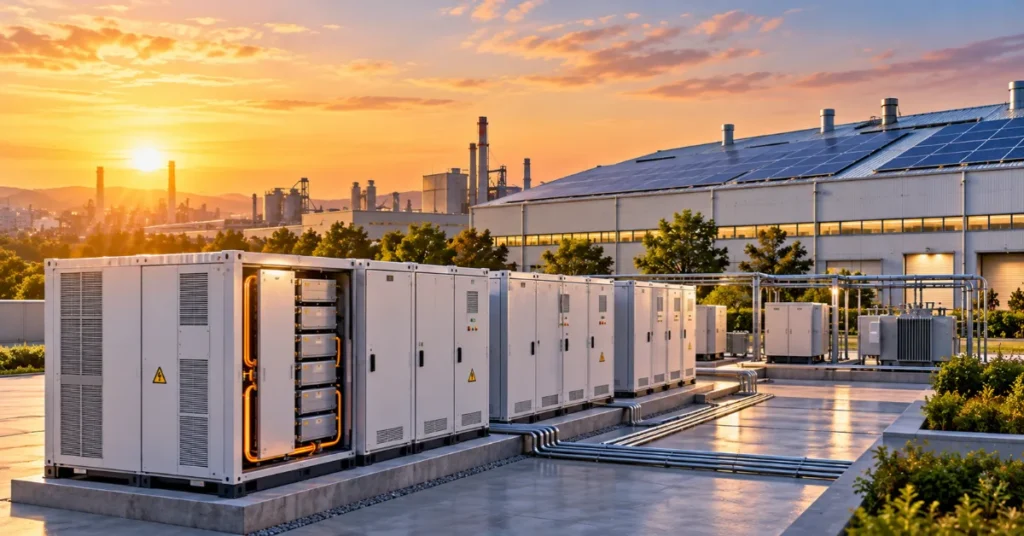
A battery energy storage system is an advanced technology that stores electrical energy in rechargeable batteries and releases it when required. The electricity can come from the grid, a rooftop solar installation, or another compatible power source.
A BESS typically consists of several components:
- Battery cells and modules: Store electrical energy for later use.
- Battery Management System (BMS): Monitors battery performance, temperature, voltage, and safety parameters.
- Power Conversion System (PCS): Converts electricity between AC and DC as required.
- Energy Management System (EMS): Controls charging and discharging based on energy demand and operating conditions.
- Thermal management and safety systems: Help maintain suitable operating conditions and manage potential battery-related risks.
Together, these components allow businesses to manage electricity consumption more intelligently.
Modern battery energy storage systems (BESS) can be configured for different power requirements, storage durations, and operational needs.
Why Do Commercial and Industrial Businesses Need BESS in 2026?
1. Reduce Peak Electricity Demand
Electricity demand is very high during specific operating hours in some industrial units. Depending on the applicable tariff structure, this can lead to higher demand-related charges.
A properly configured BESS can discharge during selected periods of high demand, which helps reduce the need to draw power from the grid and lower demand charges. Actual savings depend on the facility’s tariff, load profile, and battery operating strategy.
2. Improve Rooftop Solar Utilisation
Commercial and industrial facilities often generate excess solar power during the day, when consumption is relatively low. In the absence of storage, this extra electricity can be fed into the grid under the applicable settlement mechanism.
A BESS can store some of this excess energy and supply it later, such as during evening shifts or when solar power generation is low. This can increase the amount of solar electricity used by the facility.
3. Support Power Reliability
A sudden power outage can impact production schedules, equipment, refrigeration, and other essential operations.
If a BESS is designed with adequate backup capacity, it can provide power during an outage. However, backup operation depends on the system architecture, inverter configuration, protection equipment, and the specific loads selected for backup.
It should not be assumed that every grid-connected battery automatically provides backup power.
4. Improve Energy Cost Management
A BESS can charge when electricity is relatively cheap or when there is abundant solar power generation, and discharge when electricity is expensive. This strategy is often referred to as ‘energy arbitrage’.
Businesses should compare potential savings with the costs of battery wear and degradation, maintenance, and financing before investing in a BESS.
How Does BESS Work With Commercial Solar?
Combining solar power with a battery storage system creates more flexibility in how a business uses electricity.
For example, consider a manufacturing unit with rooftop solar that generates electricity mainly during daylight hours. The factory may consume most of this power during production but have additional demand in the evening.
A solar-plus-storage system can follow this operating sequence:
- Solar panels generate electricity during the day.
- The facility uses the electricity required for its current operations.
- Surplus generation charges the battery, subject to system limits.
- The battery stores the energy for later use.
- Stored electricity is discharged during evening demand, peak tariff periods, or a configured backup event.
This arrangement can be particularly useful for facilities with multiple shifts or significant evening electricity consumption.
However, solar and battery capacities should be planned together. A solar installation that generates little surplus electricity may not provide enough energy to charge a large battery every day.
How to Size a BESS for Your Business
Now, the question arises: what is the one most important factor to consider when you are planning to implement a battery energy storage system in India?
A system with excessive capacity can drive up the initial investment, whereas one with insufficient capacity may fail to deliver the expected benefits.
Businesses should consider the following factors.
1. Analyse Your Electricity Consumption
Review at least 12 months of electricity bills, tariff details, and available interval-meter data. Identify peak-demand periods, operating hours, daily consumption, and seasonal variations.
For more accurate planning, examine electricity usage at hourly or shorter intervals instead of relying only on monthly consumption figures.
2. Identify the Main Purpose
Decide whether the battery is primarily intended for peak-demand management, solar energy shifting, backup power, or a combination of these objectives.
Each purpose requires a different operating strategy and may produce a different financial outcome.
3. Calculate Power and Energy Requirements
Battery power is measured in kilowatts (kW) or megawatts (MW), while energy capacity is measured in kilowatt-hours (kWh) or megawatt-hours (MWh).
For example, a facility that needs 200 kW of battery output for three hours requires 600 kWh of usable energy as a starting estimate.
The final installed capacity may need to be higher to account for conversion losses, operating limits, reserve requirements, and battery degradation over time.
4. Check Solar Generation and Available Space
For a solar-plus-storage project, compare the battery’s charging requirements with the facility’s expected surplus solar generation.
Also assess installation space, ventilation or cooling requirements, electrical infrastructure, fire safety, and maintenance access.
Also Read: Why Does Engineering Matter in a Solar EPC Company?
Understanding the Battery Energy Storage System Market in India
As the country expands its renewable energy capacity and develops solutions to manage variable electricity generation, the Indian market is increasingly focused on the battery energy storage system.
The Central Electricity Authority and the Ministry of Power have highlighted the importance of energy storage for grid stability and the integration of renewable energy.
Government initiatives, including ‘Viability Gap Funding’ for eligible projects, are also aiding the development of storage infrastructure.
For commercial and industrial buyers, these developments reflect growing interest in energy storage. However, the commercial models, requirements, and economics differ between large grid-scale projects and ‘behind-the-meter’ business installations.
When evaluating the battery energy storage system market, companies should look beyond just overall market growth.
This involves considering various factors, such as the cost of installed projects, battery chemistry, warranty terms, service support, applicable electricity tariffs, and the estimated cost of stored energy.
Lithium Iron Phosphate (LFP) batteries are an option worth considering, as they are used in stationary storage applications. The final choice of technology should depend on the project’s safety requirements, operating conditions, lifecycle costs, and supplier capabilities.
Also Read: Solar EPC Company Guide — How to Choose the Right Partner
What Should Businesses Check Before Investing in BESS?
Before finalising a project, businesses should evaluate:
- Total project cost: Include batteries, inverters, control systems, installation, electrical upgrades, and commissioning.
- Battery warranty: Review the warranty period, throughput limits, retained-capacity conditions, and exclusions.
- Round-trip efficiency: Understand how much energy is available after charging and discharging losses.
- Safety and compliance: Check applicable electrical, fire-safety, installation, and regulatory requirements.
- Maintenance and monitoring: Confirm service availability, remote monitoring, and replacement arrangements.
- Financial viability: Calculate expected annual savings, operating expenses, degradation, financing costs, and payback period.
- System integration: Ensure compatibility with the existing grid connection, solar plant, and critical electrical loads.
Also Read: Why Choosing the Right Industrial Solar Company Matters
Conclusion
A battery energy storage system can help commercial and industrial businesses improve energy management, increase solar self-consumption, manage peak demand, and support selected critical loads during power interruptions.
However, BESS is not automatically the right investment for every facility. Its value depends on the site’s electricity consumption, tariff structure, solar generation, operating schedule, and storage requirements.
For businesses planning solar or energy infrastructure upgrades in 2026, the best starting point is a detailed load analysis and a project-specific financial assessment. With proper sizing, engineering, and operating strategy, BESS can become a valuable part of a more efficient, resilient energy system.
Frequently Asked Questions:
Q1. What is a battery energy storage system used for?
A battery energy storage system stores electricity for later use, helping businesses reduce energy costs, use solar power efficiently, and maintain backup power.
Q2. Is BESS suitable for Indian factories?
Yes, BESS can help Indian factories manage peak electricity demand, reduce power costs, and improve energy reliability.
Q3. Can BESS be installed with rooftop solar?
Yes, BESS can store excess electricity generated by rooftop solar panels for use when sunlight is unavailable.
Q4. How do businesses calculate the required BESS capacity?
Businesses can calculate BESS capacity by analysing their electricity usage, power needs, and the number of hours they need stored energy.