

Introduction
As businesses look for ways to reduce electricity costs and meet sustainability goals, solar energy has become a practical solution. Among the various options for installing solar energy systems, ground-mounted solar systems have become a preferred choice for commercial and industrial businesses.
Installing a ground-mounted solar system can help businesses generate their own electricity, reduce dependence on grid power and manage long-term energy costs. However, choosing the right location and planning the installation require careful consideration.
Factors such as soil strength, availability of sunlight, the design of the mounting structure, and grid connectivity can influence installation costs and long-term performance.
In this guide, we will explore seven important factors to consider before installing a ground-mounted solar system.
1. Land Availability and Site Conditions
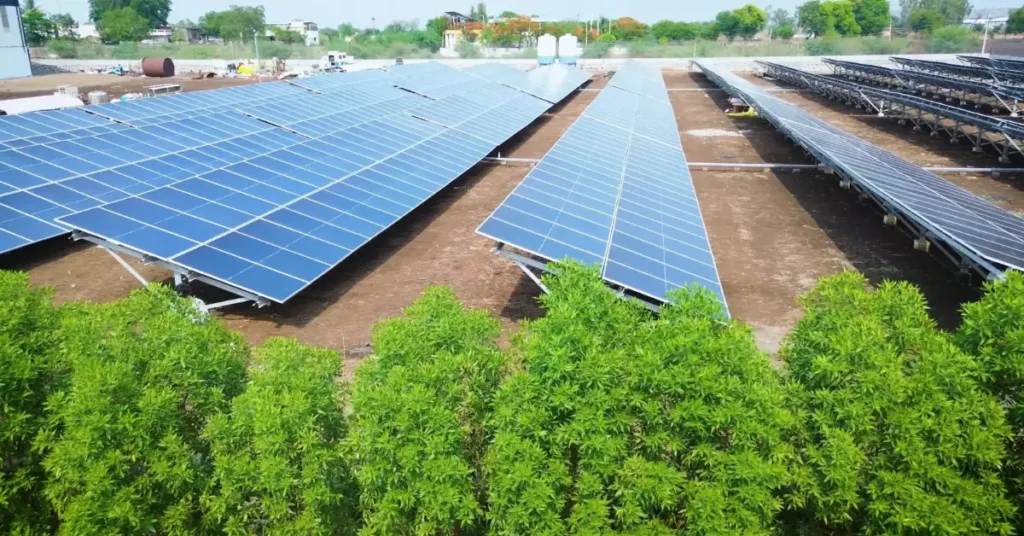
Before planning a ground-mounted solar installation, it is essential to evaluate the land. The available space must be able to accommodate the solar panels, mounting structures, inverters, transformers, and maintenance pathways.
Uneven surfaces, steep slopes and irregular boundaries can increase site preparation costs.
Before selecting a location, consider:
- Whether sufficient land is available for the planned solar capacity.
- Whether nearby buildings or trees create shadows.
- Whether there is enough space between panel rows.
- Whether the site allows easy maintenance and future expansion.
A proper site survey helps determine whether the land is suitable for the project.
Before selecting a location, businesses should also estimate their energy requirements and understand how to size an industrial solar system.
2. Soil Quality and Foundation Strength
Soil conditions directly affect the stability of ground-mounted solar structures. The foundation must support the panels and mounting system, while also being able to withstand environmental forces such as strong winds and heavy rain.
Different types of soil require different foundation designs. Rocky, sandy, and clay soils may need different installation methods.
A geotechnical soil investigation helps engineers understand soil composition, load-bearing capacity, groundwater levels, and suitable foundation requirements.
Depending on site conditions, engineers may select driven piles, ground screws or concrete foundations. The final selection should be based on the results of soil tests and structural calculations.
3. Sunlight Availability and Panel Orientation
Solar panels need sufficient sunlight to generate electricity efficiently. Therefore, the selected location should receive good sunlight throughout the day with minimal shading.
Trees, nearby buildings and other obstacles can cast shadows on ground-mounted solar panels, reducing electricity generation.
Both the orientation and the tilt angle of the panels are equally important. In India, south-facing panels are generally preferred for fixed-tilt installations. However, the most suitable configuration depends on the project site and electricity generation requirements.
Solar radiation and shading analysis helps engineers determine the suitable placement of panels and the distance between them.
4. Choosing the Right Solar Mounting Structure
The mounting structure supports solar panels and keeps them in the correct position throughout their lifespan. Selecting an appropriate solar ground mounting structure is important for the safety and durability of the installation.
Consider these points:
- Material quality: Choose durable materials with suitable corrosion protection.
- Structural strength: Ensure the structure can handle calculated wind loads.
- Installation design: Select a structure that allows safe installation and maintenance.
- Panel compatibility: Check whether the structure supports the selected panel dimensions and weight.
When designing mounting systems, engineers should consider local wind conditions, foundation requirements, and panel specifications.
Also Read: Why Does Engineering Matter in a Solar EPC Company?
5. Drainage and Local Weather Conditions
Poor drainage can create problems for ground-mounted solar systems. During heavy rainfall, the accumulation of water around the foundations and electrical equipment can affect the stability of the structure and electrical safety.
Before finalising the site, examine its natural drainage patterns and its history regarding flooding or waterlogging.
Important measures include providing drainage, preparing a suitable foundation, protecting electrical equipment from water, and using weather-resistant materials.
During project design, variations in local wind speed, rainfall, and temperature should also be taken into account.
Also Read: Commercial Solar Installation Cost in India 2026 | Complete Guide
6. Grid Connectivity and Electrical Infrastructure
A ground-mounted solar plant requires suitable electrical infrastructure to supply power to a business or export power to the grid.
The distance between the solar plant and the connection point can impact cable requirements, electrical losses, and the overall project cost.
Also Read: Solar Open Access vs Rooftop Solar: Which Is Better for Your Business?
Before installation, evaluate:
- Distance from the nearest suitable grid connection point.
- Availability of grid evacuation capacity.
- Requirements for transformers and inverters.
- Cable routing and electrical safety.
- Applicable grid connectivity approvals.
For large ground-mounted solar projects, grid evacuation planning is particularly important. Limited grid capacity can delay commissioning or restrict electricity export.
7. Maintenance Access and Future Expansion
Ground-mounted solar systems are long-term investments, so maintenance should be considered during initial planning.
The layout should provide enough space for cleaning, inspection and repairs. Consider:
- Access roads for maintenance vehicles.
- Adequate spacing between panel rows.
- Safe cleaning and inspection pathways.
- Vegetation control around solar panels.
- Security arrangements.
Businesses should also consider future expansion. Leaving sufficient space for additional panels and electrical infrastructure can make upgrades easier when energy requirements increase.
Why Choose Alligator Solar for Ground-Mounted Solar Projects
Alligator Solar is a trusted commercial and industrial solar EPC company, providing reliable and affordable solar energy solutions across India. Established in 2015 as the renewable energy division of the Alligator Group, the company specialises in rooftop and ground-mounted solar projects.
It offers a diverse range of integrated solutions, including on-site solar, open-access solar, OPEX and CAPEX models, Battery Energy Storage Systems (BESS), and EV charging infrastructure.
With a focus on engineering excellence, quality execution, safety, and customer satisfaction, Alligator Solar helps businesses reduce electricity costs, improve energy reliability, and achieve their sustainability goals through dependable clean energy solutions.
Conclusion
Installing a ground-mounted solar system is a significant investment that requires proper planning and site evaluation.
Factors such as land availability, soil quality, sunlight exposure, mounting structure design, drainage and grid connectivity play an important role in the project’s overall performance.
By evaluating these factors before installation, businesses can avoid unexpected costs, reduce potential technical issues and ensure better energy generation. Businesses should carefully evaluate their energy requirements before choosing an open access model.